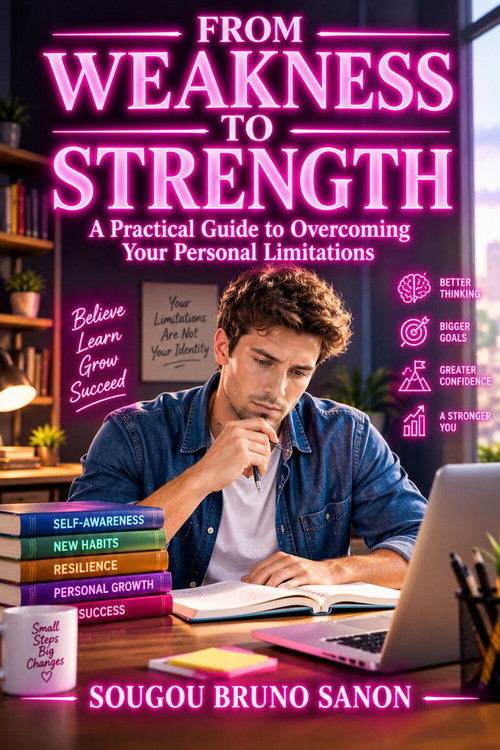
Every human being has weaknesses, limitations, and personal struggles. Some are visible to others, while others remain hidden deep within our thoughts, emotions, habits, and beliefs. These weaknesses can prevent us from reaching our potential, building healthy relationships, achieving our goals, and living with confidence. However, having weaknesses does not mean that we are incapable of growth. Our limitations do not define our identity or determine our future. They simply reveal areas where awareness, learning, and intentional effort are needed. The journey from weakness to strength beginswhen we stop denying our limitations and start seeing them as opportunities for personal development.
The first step toward meaningful change is understanding our weaknesses through honest self-awareness. We cannot effectively improve what we refuse to recognize. By observing our thoughts, emotions, habits, reactions, and recurring mistakes, we begin to understand the patterns that influence our behavior. Self-awareness allows us to identify our triggers, recognize our strengths, acknowledge our shortcomings, and take responsibility for our choices. Instead of blaming circumstances or condemning ourselves, we learn to ask constructive questions: What is happening? Why do I respond this way? What can I learn from this experience? What can I do differently next time? These questions transform self-examination into a foundation for growth.
Another essential lesson is the power of reframing our weaknesses and changing our perspective. Sometimes, what we consider a weakness may contain a quality that needs direction rather than elimination. Sensitivity, for example, can become empathy; fear can encourage preparation; impatience can be redirected into productive energy; and excessive thinking can be transformed into thoughtful planning. Nevertheless, reframing does not mean making excuses for harmful behavior or pretending that every weakness hides a strength. Genuine transformation requires honest evaluation, the willingness to correct destructive patterns, and the wisdom to preserve useful qualities while changing what holds us back. By changing how we understand our limitations, we open the door to better choices and new possibilities.
Awareness and a positive mindset, however, are not enough without practical action. Overcoming personal limitations requires clear goals, realistic strategies, supportive habits, and consistent practice. Large challenges become more manageable when divided into smaller steps. Identifying triggers, adjusting our environment, improving time management, regulating our emotions, seeking constructive feedback, and tracking our progress can help us replace unproductive behaviors with healthier alternatives. Progress does not always happen quickly, and no single strategy works perfectly in every situation. We must therefore remain patient, evaluate our results, learn from experience, and adjust our methods whenever necessary. Sustainable improvement is built through repeated actions, not occasional bursts of enthusiasm.
The journey also requires emotional resilience and self-compassion. Change can be uncomfortable, and setbacks are a natural part of personal development. We may sometimes return to old habits, experience disappointment, or question our ability to improve. During these moments, self-criticism can make the struggle even more difficult. Self-compassion teaches us to treat ourselves with understanding without abandoning responsibility. Resilience helps us recover, learn, and continue moving forward. Rather than interpreting every mistake as proof of failure, we can treat it as information that guides our next decision. Our emotions deserve acknowledgment, but they do not have to control our actions. By combining emotional awareness, healthy coping strategies, supportive relationships, and constructive responses, we become better equipped to face adversity without losing sight of our goals.
As we progress, we learn that certain weaknesses can gradually become strengths when we understand them and deliberately develop better responses. The person who once struggled with fear may become courageous through repeated acts of preparation and action. Someone who overreacted emotionally may develop greater self-control through reflection and practice. A person who once lacked confidence may build it by keeping small promises to themselves and recognizing evidence of progress. These transformations do not happen automatically. They require commitment, accountability, patience, and a willingness to practice new behaviors even when the results are not immediately visible. The objective is not to become perfect but to become more capable, responsible, and effective than we were before.
Maintaining momentum is another important part of lasting change. Initial excitement often fades, daily responsibilities increase, and progress may become less noticeable. For this reason, personal growth must eventually depend less on motivation and more on purpose, discipline, and consistent routines. Remembering why we began, setting small achievable goals, celebrating meaningful progress, reviewing our experiences, and surrounding ourselves with supportive people can help us remain committed. Flexibility is equally important because life changes, circumstances shift, and some strategies need to be revised. When we encounter difficulties, we do not have to abandon our journey; we can pause, learn, adjust, and begin again. Every small constructive action contributes to the larger transformation we seek.
Ultimately, From Weakness to Strength presents personal development as an ongoing journey of awareness, responsibility, practice, and continuous learning. The purpose is not to eliminate every imperfection or compare ourselves constantly with others. It is to understand ourselves more deeply, manage our limitations wisely, strengthen our abilities, and make choices that reflect the person we aspire to become. True growth occurs when knowledge becomes action, action becomes habit, and habits gradually shape character. Each challenge offers an opportunity to develop patience, courage, discipline, wisdom, and perseverance.
The most important message of this book is that your weaknesses may influence your present, but they do not have to control your future. You may not be able to change everything about yourself overnight, and some limitations may require ongoing management, but you can learn to respond to them differently. You can replace excuses with responsibility, fear with preparation, self-condemnation with constructive reflection, and discouragement with renewed effort. Every honest assessment, every small improvement, and every decision to continue contributes to your growth. The power to change begins with recognizing where you are, accepting responsibility for what you can influence, and taking the next practical step.
Your journey from weakness to strength begins with a decision: to stop allowing your limitations to define you and start using them as opportunities to learn, develop, and move forward. You do not need to have everything figured out before you begin. You only need the willingness to take the first step, the courage to continue when progress becomes difficult, and the humility to keep learning along the way. As you grow stronger, your transformation can also become a source of encouragement and support for others who are facing their own struggles.
Remember: Personal growth is not about becoming someone who has no weaknesses. It is about becoming someone who understands their weaknesses, takes responsibility for them, and develops the strength and wisdom to manage them effectively. Your limitations are part of your story, but they do not have to be the conclusion.
The journey from weakness to strength is possible, one decision, one habit, and one day at a time.