BookRixBookRix
  • Home
  • Stories
  • Channels
  • FAQ
  • Login
  • Sign up
  • Sign up
© Copyright 2025 - BookRix powered by StreetLib Srl
This website is a property of BookRix, Germany.
BookRix and its parent company StreetLib S.r.l. own all intellectual property rights for brands, logos and distinctive signs existing on all websites under the domains bookrix.de and streetlib.com. We kindly ask the user to read our privacy policy and conditions for the services offered by BookRix. Customer Service: support@bookrix.de
Contact us | Privacy Policy | Terms and conditions
HomeBook StoreThe Art of Effective Marketing
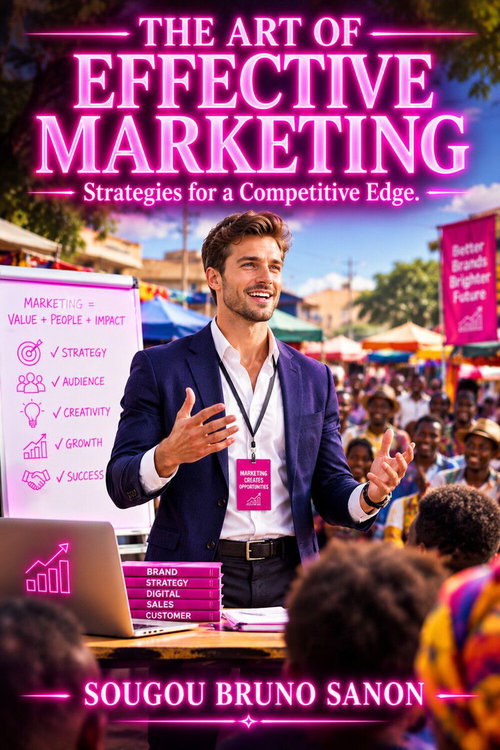
The Art of Effective Marketing

The Art of Effective Marketing

ISBN: 978-3-6952-6770-5
Book Type: E-Book
Subscribe for5,99 €/ month
Enjoy this book while gaining access to the complete catalogue
Start Reading
Requires BookRix App (iOS/Android), Mobile Only, Cancel anytime
Subscribe for5,99 €/ month
Enjoy this book while gaining access to the complete catalogue
Start Reading
Requires BookRix App (iOS/Android), Mobile Only, Cancel anytime
Description
The Art of Effective Marketing: Strategies for a Competitive Edge presents marketing as more than advertising, promotion, or selling. It is a strategic process of understanding customers, creating meaningful value, communicating effectively, building relationships, and adapting to competition. The book explains how organizations can achieve sustainable growth by connecting customer insight, branding, differentiation, strategic planning, digital engagement, human relationships, measurement, and continuous improvement. 1. Understanding the Market and the Customer Effective marketing begins withunderstanding customers' needs, frustrations, aspirations, behaviors, and expectations. Market research, observation, customer feedback, and competitor analysis help businesses replace assumptions with evidence. Understanding the customer journey also reveals opportunities to improve products, services, and experiences. The principle is simple: the better an organization understands its customers, the more effectively it can serve them. 2. Building a Strong Brand Identity A brand is more than a logo or slogan. It represents an organization's purpose, promises, reputation, and customer experience. A strong brand requires clear positioning, consistent communication, a recognizable identity, and reliable delivery. When businesses fulfill their promises, they build credibility and trust. The goal is not merely to become known but to become remembered, respected, and preferred. 3. Product and Service Differentiation In competitive markets, businesses need meaningful reasons for customers to choose them. Differentiation may come from quality, innovation, pricing, convenience, customer service, technology, or experience. However, being different matters only when customers value that difference. Organizations must identify what their audiences appreciate and deliver it better or more distinctively than competitors. Effective differentiation creates preference and reduces dependence on price competition. 4. Developing a Strategic Marketing Plan A marketing plan transforms ideas into coordinated action. It establishes objectives, target audiences, positioning, strategies, tactics, budgets, timelines, and performance indicators. Strategy determines where and how an organization intends to compete, while tactics are the actions used to implement that strategy. A strong plan provides direction, coordinates resources, and measures progress while remaining flexible enough to respond to changing market conditions. 5. Exploring Digital Marketing Digital marketing enables organizations to attract, engage, convert, and retain customers through websites, search engines, social media, email, online advertising, content, analytics, automation, and artificial intelligence. Success requires more than an online presence. Businesses must provide useful content, communicate clearly, simplify purchasing, build trust, and maintain customer relationships. Technology can improve efficiency and personalization, but it should complement human understanding rather than replace it. 6. Building Human Connections Marketing remains fundamentally human. Customers value trust, recognition, personal attention, community, and memorable experiences. Networking, events, partnerships, referrals, and personalized service strengthen relationships and credibility. Digital channels expand reach, while personal interactions deepen trust. Combining both approaches creates stronger customer experiences and encourages loyalty, repeat purchases, and recommendations. 7. Measuring Performance and Adapting Effective marketing requires measurable objectives and relevant indicators, including conversion rates, customer acquisition cost, customer lifetime value, engagement, retention, and profitability. These metrics help organizations identify what works, recognize weaknesses, and allocate resources more effectively. However, data becomes valuable only when it informs decisions. Marketing therefore follows a continuous cycle: measure, analyze, experiment, learn, adapt, and repeat. 8. Learning from Successful Campaigns Marketing campaigns associated with Dove, Airbnb, Old Spice, Glossier, and Nike illustrate the power of customer insight, emotional storytelling, creativity, positioning, and community engagement. The goal is not to copy successful companies but to understand the principles behind their achievements and adapt relevant lessons to different markets. Effective campaigns combine customer understanding, creative thinking, strategic execution, and continuous evaluation. Marketing as an Integrated System The eight chapters demonstrate that marketing succeeds when its elements work together. Customer understanding guides value creation. Differentiation strengthens positioning. Branding builds trust. Planning coordinates action. Digital and personal connections engage customers. Measurement reveals results, while learning and adaptation drive improvement. Marketing is therefore not a collection of isolated activities but a connected system designed to create customer value and sustainable growth. Adapting to Change Consumer expectations, technologies, competitors, and communication channels continually evolve. Artificial intelligence is also transforming marketing research, content creation, personalization, and customer engagement. Organizations must remain curious, flexible, and willing to experiment. They should learn from mistakes, recognize new opportunities, and improve ineffective strategies without abandoning their fundamental purpose and values. The ability to learn and adapt faster than competitors is an important source of lasting advantage. The Power of Value and Relationships Customers seek more than products; they seek solutions, convenience, confidence, belonging, and desirable outcomes. Organizations that understand these motivations can create experiences that genuinely improve customers' lives. Consistently delivering meaningful value strengthens trust, encourages repeat purchases, and generates recommendations. Sustainable marketing is therefore not simply about making sales but about building relationships that benefit both customers and organizations. The Continuous Cycle of Effective Marketing The philosophy of the book can be summarized as: Understand + Create Value + Differentiate + Build the Brand + Plan + Connect + Measure + Learn + Adapt + Repeat. Understanding generates insight. Insight guides value creation. Value supports differentiation. Branding and planning strengthen execution. Customer connections deliver the experience. Measurement reveals performance, while learning and adaptation produce better strategies. This cycle enables organizations to improve continuously and remain relevant in changing markets. Conclusion: Building a Lasting Competitive Edge. The strongest competitive advantage does not necessarily belong to the organization with the largest budget or the newest technology. It belongs to the organization that understands customers deeply, creates meaningful value, communicates clearly, builds trustworthy relationships, learns from evidence, and adapts effectively. The art of marketing lies in balancing science with creativity, data with intuition, technology with humanity, and short-term performance with long-term relationships. Although tools, platforms, and consumer behaviors will change, the fundamental principle remains: understand people, serve them well, earn their trust, and continually improve the value you provide. Understand deeply. Create meaningful value. Differentiate boldly. Build a trustworthy brand. Plan strategically. Connect digitally and personally. Measure intelligently. Learn continuously. Adapt courageously. Serve exceptionally. That is the art of effective marketing and the foundation of a lasting competitive edge.
Read more

More by the Author

Built to win
Built to win
Sougou Bruno SANON
Audiobook
How to become more than a conqueror
Sougou Bruno SANON
E-Book
The whole truth
The whole truth
Sougou Bruno SANON
E-Book
Infallible steps leading to success
Sougou Bruno SANON
E-Book
A good leader
A good leader
Sougou Bruno SANON
E-Book
Love what is it?
Love what is it?
Sougou Bruno SANON
E-Book
Who is God?
Who is God?
Sougou Bruno SANON
E-Book
QU’EST-CE QUE L’AMOUR?
Sougou Bruno SANON
E-Book
LES pas infaillibles qui mènent au succès
Sougou Bruno SANON
E-Book