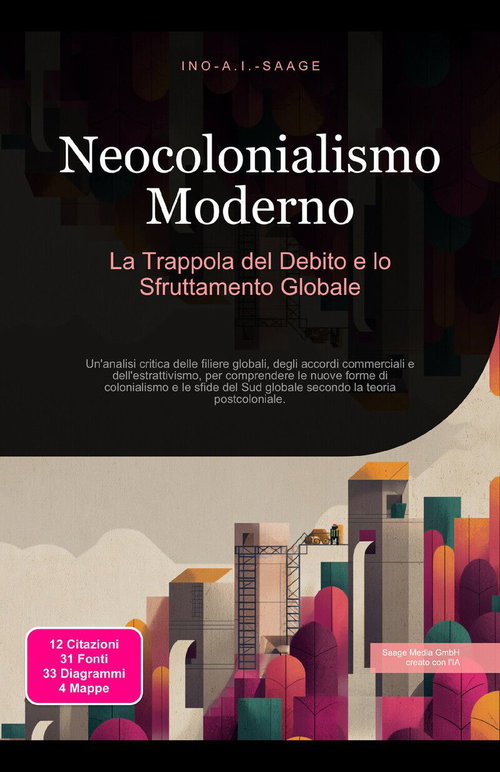
This book provides an in-depth analysis of the mechanisms of neocolonialism in the 21st century. It examines how economic instruments and practices perpetuate global inequalities, building on the legacy of historical colonialism. The work is informed by postcolonial theory and focuses on the structures that maintain economic dominance over the Global South.
The first sections explore the economic tools of modern colonialism. This includes a detailed look at the architecture of global debt, analyzing how the debt trap is created and sustained through the conditions of international financialinstitutions and opaque credit agreements. It also dissects unequal trade agreements, focusing on investment protection clauses, market-distorting subsidy policies, and the use of intellectual property rights. Furthermore, the book investigates the control over global supply chains, highlighting the asymmetric distribution of value and the externalization of social and environmental costs.

Subsequent chapters are dedicated to the tangible forms of exploitation. The analysis covers modern extractivism and resource extraction, linking the mining of raw materials to ecosystem destruction and the displacement of indigenous and local communities. The mechanisms of large-scale land grabbing and its consequences for food sovereignty are also discussed, contrasting the expansion of export monocultures with the needs of local food supply.
Finally, the book addresses pathways towards decolonization and global justice. It presents postcolonial theory as a tool for recognizing colonial continuities and questioning Eurocentric worldviews. The text suggests strategies for strengthening local and transnational civil society, advocating for fair political frameworks like transparent trade agreements and binding supply chain laws, and promoting sovereign development paths beyond the structures of neocolonialism.


For this book, we have used modern technologies – including Artificial Intelligence and individually developed software solutions. They were used in many phases of the creation process: from brainstorming and research to writing and editing, as well as quality assurance and the design of the decorative illustrations.
Our goal is to offer you a reading experience that is particularly coherent and contemporary. The content of this book is, for the most part, AI-generated.