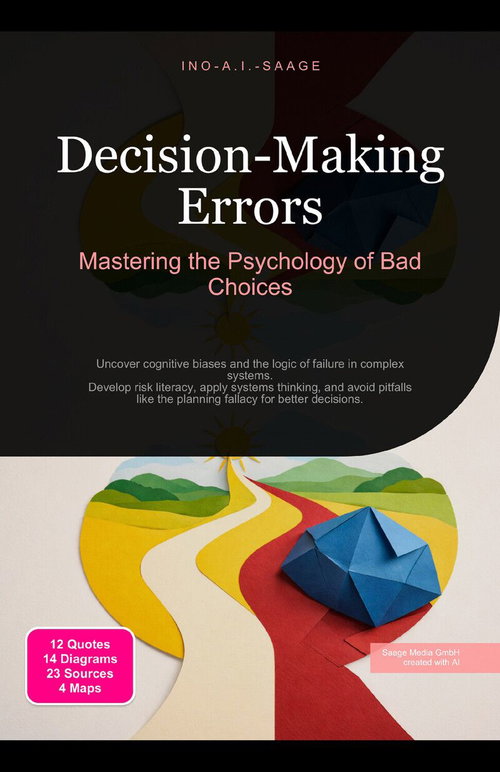
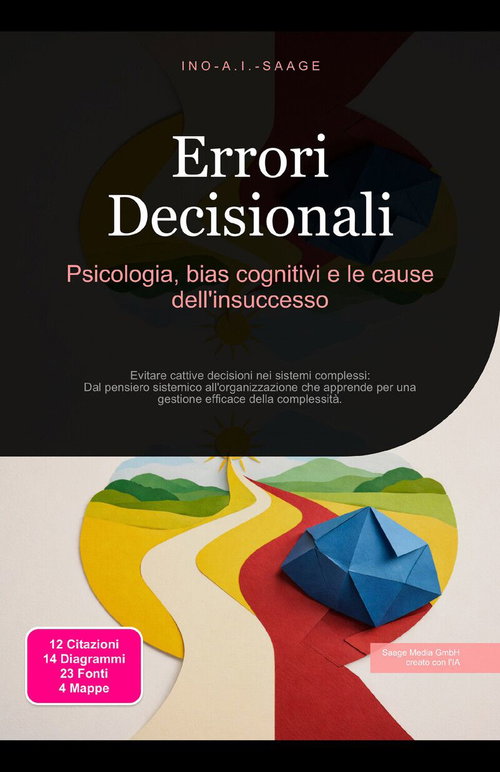
This book offers a structured exploration into the psychology of decision-making errors and provides methods for improving judgment in personal and professional contexts.
It begins by examining the psychological foundations of flawed choices, focusing on cognitive biases that affect perception, memory, and judgment. Topics include the mechanisms of selective perception, the hindsight bias, and the availability heuristic. The text also analyzes the impact of the social environment, such as groupthink and obedience to authority, on individual decision-making. A significant section is dedicated tocognitive biases in judgment, including the anchoring heuristic, the representativeness heuristic, and the planning fallacy.
The second part addresses the dynamics of failure in complex systems. It introduces the fundamentals of systems thinking, explaining concepts like interconnectedness, dynamics, and time-delayed feedback. Readers will learn to apply systems thinking by visualizing causal loops, modeling feedback mechanisms, and identifying effective leverage points for intervention.
Finally, the book presents concrete strategies for avoiding bad decisions. It outlines how to develop personal risk awareness by improving one's understanding of probabilities and managing emotional influences. Structured decision-making processes, such as criteria-based analysis and the pre-mortem method, are detailed. The discussion extends to the organizational level, covering the creation of a constructive risk culture, the development of learning organizations, and tools for preventing decision-making errors in teams. The goal is to provide a comprehensive understanding of why we make mistakes and to offer practical approaches for making better, more informed choices.


For this book, we have used modern technologies – including Artificial Intelligence and individually developed software solutions. They were used in many phases of the creation process: from brainstorming and research to writing and editing, as well as quality assurance and the design of the decorative illustrations.
Our goal is to offer you a reading experience that is particularly coherent and contemporary. The content of this book is, for the most part, AI-generated.