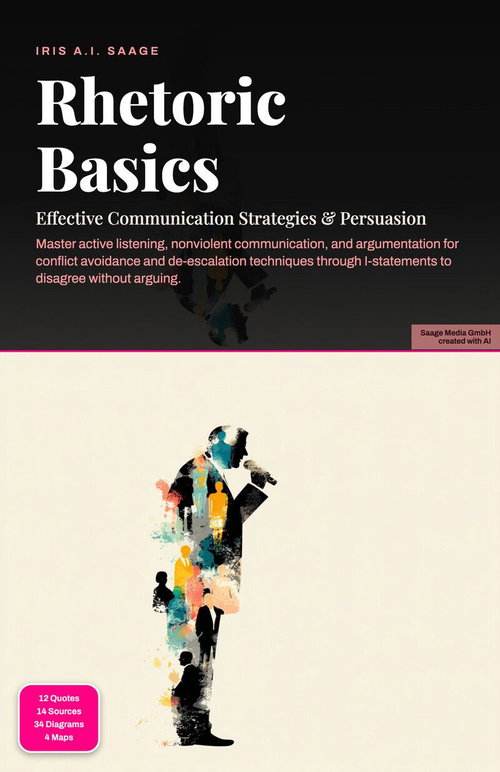
This guide provides a structured approach to improving your communication skills and mastering the art of persuasion.
Learn the fundamentals of effective conversation, beginning with the crucial technique of active listening. This book shows you how to send clear signals of understanding, accurately summarize content, and recognize emotional undertones to build stronger connections. You will also develop clarity in your own expression by choosing precise words and structuring your information effectively. A section on nonverbal communication will help you consciously use body language and vocaltone to support your message.

The content then moves to communication strategies designed for persuasion. Discover how to build coherent arguments, use logical connections, and employ analogies to make your points more understandable. The book also introduces psychological persuasion techniques, such as the principle of reciprocity and social proof, while explaining how to build credibility.
A key focus is on conflict avoidance and conflict resolution. You will be introduced to the principles of nonviolent communication, learning to formulate observations without judgment and to clearly express your own feelings and needs. A significant part is dedicated to the use of I-statements, providing a method to disagree without arguing. Learn to transform accusations into constructive requests and create a respectful atmosphere in your conversations.
For situations where conflicts are already present, the book offers concrete de-escalation techniques. It explains how to de-escalate emotional outbursts, use strategic pauses, and shift the focus from problems to solutions. You will find methods for collaborative conflict resolution, such as negotiating interests instead of positions and developing options for mutual benefit. By applying these rhetorical and conversation skills, you can enhance your ability to navigate challenging discussions and achieve more positive outcomes through refined communication strategies.
For this book, we have used modern technologies – including Artificial Intelligence and individually developed software solutions. They were used in many phases of the creation process: from brainstorming and research to writing and editing, as well as quality assurance and the design of the decorative illustrations.
Our goal is to offer you a reading experience that is particularly coherent and contemporary. The content of this book is, for the most part, AI-generated.