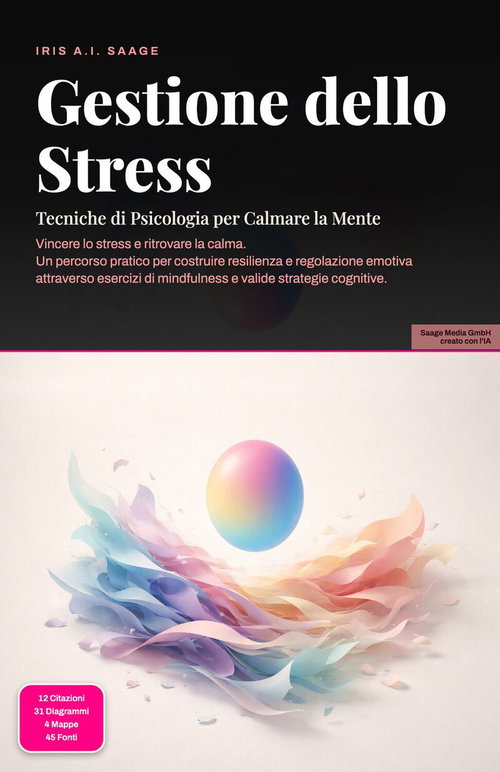
This guide to stress management offers a structured approach, grounded in psychology, to help you navigate the complexities of modern life. It provides insights and practical methods to better understand and manage your personal responses to stress, worry, and uncertainty.
The book begins by laying a foundation in analysis of psychological stress. You will learn to identify your specific external stressors and internal factors. It guides you in observing your physical and emotional reactions and in evaluating your own thought patterns through techniques like journaling. This section also exploresthe mechanisms of emotional regulation, helping you to recognize less effective coping strategies and develop a more conscious approach to your feelings.
For moments of acute pressure, you will find a collection of immediate coping mechanisms. These include body-oriented techniques for calming the mind such as breathing exercises and progressive muscle relaxation. The guide also introduces practical mindfulness exercises for everyday life, like the body scan and mindful walking, designed to enhance awareness and focus. Furthermore, it presents methods to reduce anxiety as it arises, using sensory grounding exercises and cognitive tools to create distance from overwhelming thoughts.
Moving beyond immediate relief, the book delves into cognitive behavioral therapy strategies for lasting change. You will explore how to restructure unhelpful beliefs and use behavioral experiments to challenge fears. Specific techniques are offered to beat stress, worry, and uncertainty, such as methods for channeling worries and letting them go. A key focus is on developing a greater tolerance for uncertainty by learning to reframe it.
Finally, the guide concentrates on the long-term integration of these skills to build resilience. It discusses strengthening your social support systems, cultivating optimism, and clarifying personal values to act as an inner compass. You will also find guidance on creating a supportive lifestyle through time management, prioritizing sleep, good nutrition, and physical activity. The aim is to help you sustainably practice what you have learned, fostering self-compassion and ensuring the continuous application of skills for effective stress management and emotional regulation.
For this book, we have used modern technologies – including Artificial Intelligence and individually developed software solutions. They were used in many phases of the creation process: from brainstorming and research to writing and editing, as well as quality assurance and the design of the decorative illustrations.
Our goal is to offer you a reading experience that is particularly coherent and contemporary. The content of this book is, for the most part, AI-generated.