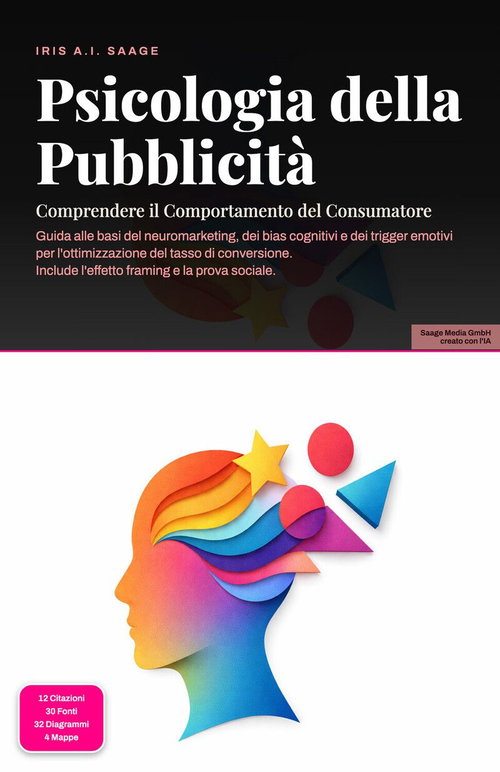
Discover the fundamental principles of advertising psychology and learn how to apply them to create more effective marketing campaigns. This book provides a detailed exploration of the psychological mechanisms that drive consumer decisions, moving beyond surface-level tactics to offer a structured understanding of buyer behavior.

Explore the core concepts of the psychology of advertising, from the interplay of rational and emotional factors in the purchasing process to the significant role of the subconscious. You will gain insights into consumer behavior models, learning how to identify keypurchasing motives and segment target audiences based on psychological characteristics.
The content guides you through the process of shaping brand perception. Understand the psychological impact of colors, shapes, and typography, and learn how to craft brand messages and slogans that resonate with your audience. A central theme is the strategic use of emotional triggers, including how to evoke positive feelings, address consumer anxieties constructively, and use curiosity to capture attention.
Delve into the practical application of cognitive biases to influence actions. The book examines powerful heuristics such as the anchoring effect for price evaluation, the scarcity principle to increase perceived value, and the use of social proof through customer reviews and expert opinions. You will also learn about the concept of loss aversion and how to frame offers to minimize perceived risk for the consumer, for instance, through trial periods or guarantees.
Finally, the book addresses the crucial aspect of measuring and optimizing advertising impact. It covers strategies for conversion rate optimization, including the design of compelling calls-to-action and the systematic execution of A/B tests. It also introduces methods from neuromarketing, such as eye-tracking and facial coding, to analyze subconscious consumer reactions and gain deeper insights for effective message framing.
For this book, we have used modern technologies – including Artificial Intelligence and individually developed software solutions. They were used in many phases of the creation process: from brainstorming and research to writing and editing, as well as quality assurance and the design of the decorative illustrations.
Our goal is to offer you a reading experience that is particularly coherent and contemporary. The content of this book is, for the most part, AI-generated.