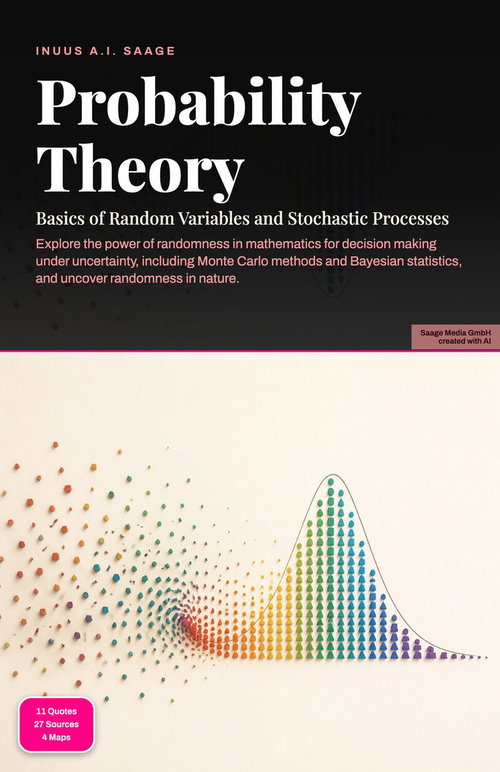
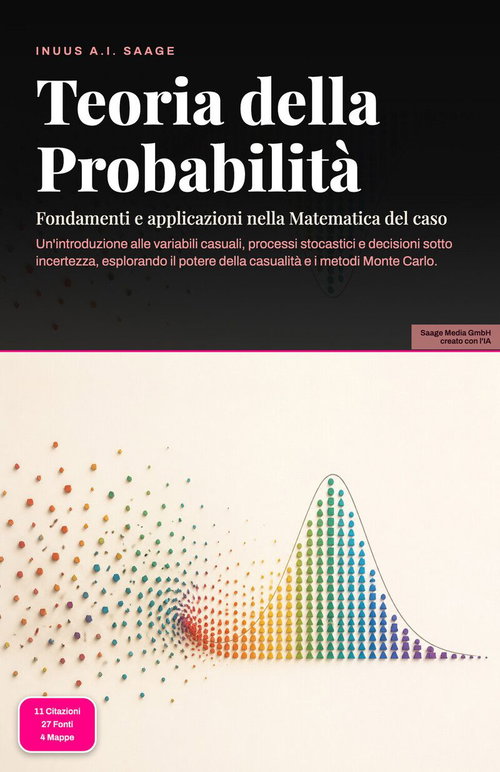
This book provides a comprehensive introduction to the fundamental concepts of probability theory and its applications in navigating uncertainty.


Beginning with the foundations of stochastics, it elucidates how mathematics can be used to formally describe and analyze uncertain situations. Readers will learn to work with probability spaces, interpret probability distributions, and understand the role of conditional probabilities. The text thoroughly explores both discrete and continuous random variables, demonstrating how they are used to model different types of events and phenomena.This includes methods for calculating key metrics like expected value and variance, which are essential for risk assessment.
The content then progresses to advanced methods of probabilistic analysis. A significant section is dedicated to Bayesian statistics, covering the formulation of prior probabilities and the application of Bayes' theorem for inference. Furthermore, the book details powerful simulation techniques, with a focus on Monte Carlo methods for solving complex problems. It also introduces the modeling of time-dependent phenomena through the study of stochastic processes, including Markov chains.
Exploring the broader applications of these mathematical tools, the text examines the concept of entropy for measuring information and disorder. It illustrates how principles of probability are used to understand randomness in nature, from biological evolution to patterns in quantum mechanics. A central theme is the practical application of this knowledge to decision-making under uncertainty. This includes strategies for rational choices, risk management, and the quantitative assessment of operational risks. By providing a structured overview of probability theory, from random variables to stochastic processes and Bayesian statistics, this work offers a solid foundation for analyzing and making informed decisions in a world governed by chance.
For this book, we have used modern technologies – including Artificial Intelligence and individually developed software solutions. They were used in many phases of the creation process: from brainstorming and research to writing and editing, as well as quality assurance and the design of the decorative illustrations.
Our goal is to offer you a reading experience that is particularly coherent and contemporary. The content of this book is, for the most part, AI-generated.