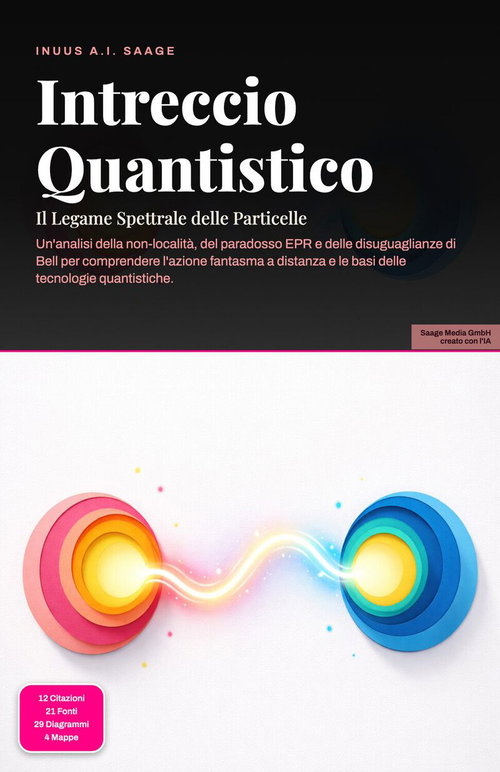
This book provides a detailed examination of quantum entanglement, one of the most intriguing phenomena in modern physics. It systematically guides you through the core concepts, from the generation of entangled particles to their application in future quantum technologies.
The content begins with the practical aspects of creating and manipulating quantum systems. It covers photon-based generation methods, such as spontaneous parametric down-conversion, and the use of quantum dots. You will learn about the techniques for manipulating quantum states through unitary operations and how the coherenceof these delicate systems is maintained by minimizing decoherence.
A central focus is on the experimental proof of nonlocality. The book delves into the famous EPR paradox, exploring the formulation of local hidden variables and contrasting them with the predictions of quantum mechanics. It then explains the role of Bell inequalities, particularly the CHSH inequality, in experimentally testing these fundamental concepts. The process of conducting Bell tests and the statistical evaluation of their results are discussed, alongside methods for quantifying entanglement.

Furthermore, the publication addresses the profound conceptual questions surrounding the 'spooky action at a distance'. It explores models of the invisible connection between entangled particles, including representations in Hilbert space and the density matrix. The text also examines considerations of causality, the no-communication theorem, and the philosophical implications concerning realism and the role of the observer in quantum mechanics.


Finally, the book bridges theory and application by exploring how quantum entanglement serves as a resource for quantum information and technologies. It outlines the fundamentals of encoding information in qubits and discusses implementations of quantum teleportation and communication protocols, such as quantum key distribution and superdense coding. This work offers a structured exploration of the EPR paradox, Bell inequalities, nonlocality, and entangled particles for anyone interested in the principles of quantum information.
For this book, we have used modern technologies – including Artificial Intelligence and individually developed software solutions. They were used in many phases of the creation process: from brainstorming and research to writing and editing, as well as quality assurance and the design of the decorative illustrations.
Our goal is to offer you a reading experience that is particularly coherent and contemporary. The content of this book is, for the most part, AI-generated.