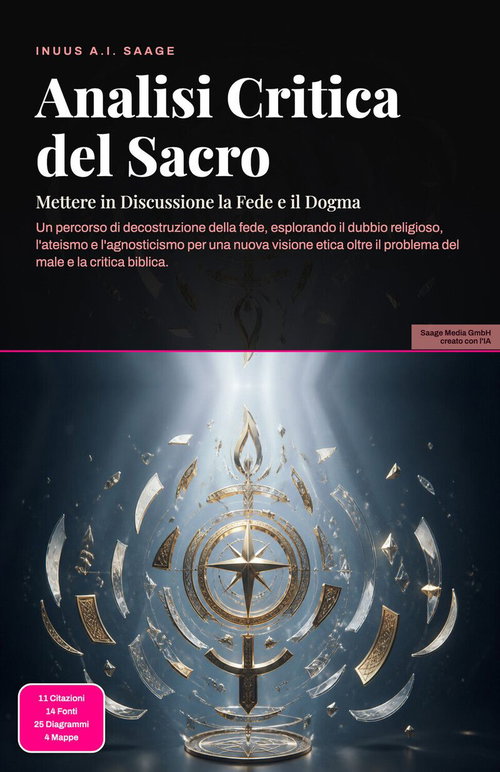
This guide offers a structured approach for individuals questioning faith and exploring the process of faith deconstruction.

It provides methodological tools for self-reflection, encouraging an examination of the emotional and cognitive barriers that can accompany religious doubt. The book delves into the application of logical reasoning to religious doctrines and offers strategies for engaging with uncertainty.
A significant portion is dedicated to the tools for the critique of religion. This includes an introduction to biblical criticism, focusing on the identification of internal contradictionsand the ethical evaluation of teachings. The text also analyzes religious institutions, their power structures, and the discrepancy between doctrine and practice. Furthermore, it addresses key philosophical objections to theism, such as the problem of evil and divine hiddenness.
The journey of leaving religion is explored in detail, outlining practical steps for re-evaluating core beliefs and navigating the social consequences of deconversion. It provides insights into communicating one's new position to family and friends and managing potential social exclusion. Psychological aspects, such as processing deep-seated feelings of guilt and fear, and finding meaning outside of religious narratives, are also covered.
Finally, the book examines the foundations for building a secular life philosophy, whether it leads to atheism or agnosticism. It discusses the establishment of a naturalistic worldview, the development of a humanistic ethic, and the principles of agnosticism as a position of intellectual honesty.
For this book, we have used modern technologies – including Artificial Intelligence and individually developed software solutions. They were used in many phases of the creation process: from brainstorming and research to writing and editing, as well as quality assurance and the design of the decorative illustrations.
Our goal is to offer you a reading experience that is particularly coherent and contemporary. The content of this book is, for the most part, AI-generated.