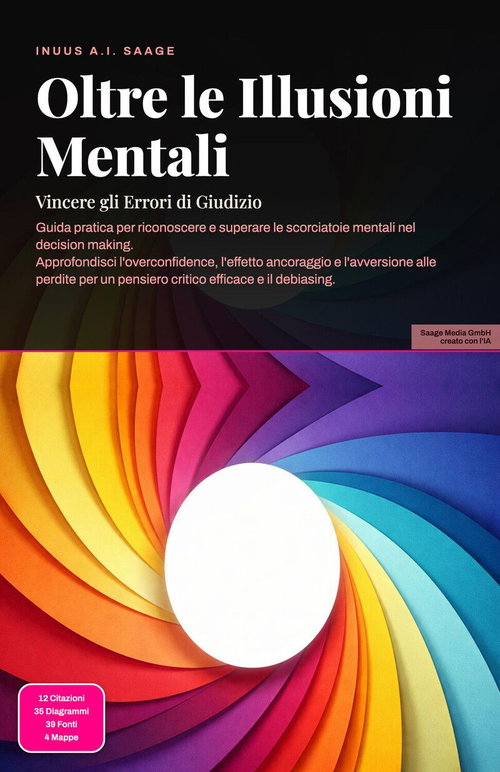
Have you ever wondered why you make certain decisions, even when they seem irrational in hindsight? "Cognitive Biases Unveiled" offers a detailed exploration into the hidden mechanisms of the human mind that shape your judgments and choices every day.
This psychology guide provides a structured look at the world of cognitive biases and thinking errors. It begins by introducing the foundational concept of System 1 and System 2, the two modes of thought that constantly influence your decision-making. You will learn how the fast, intuitive System 1 operates and how the deliberate, analytical System 2 intervenes,and the conflicts that arise between them.

The book then delves into specific, widespread cognitive biases. Gain insights into the confirmation bias, which leads you to favor information that confirms your existing beliefs. Understand the power of the anchoring effect, where an initial piece of information heavily influences subsequent judgments. Furthermore, the text examines emotional biases like loss aversion, which makes the fear of losing something more potent than the pleasure of gaining something of equal value, and the overconfidence bias in assessing your own abilities.
Beyond identification, this guide focuses on practical application. It presents a range of debiasing techniques designed to foster enhanced critical thinking. Learn methods to structure your thoughts, such as creating pro-and-con lists, and adopt new perspectives to challenge your initial assumptions. The book outlines how to implement structural aids like checklists and designated pauses to create an environment conducive to more objective decision-making.


Finally, the insights are applied to real-world scenarios, including personal finance, professional judgments, and interpersonal relationships. This book is a resource for anyone seeking to understand the psychology behind their thinking errors and develop the tools for more considered and effective decision-making.
For this book, we have used modern technologies – including Artificial Intelligence and individually developed software solutions. They were used in many phases of the creation process: from brainstorming and research to writing and editing, as well as quality assurance and the design of the decorative illustrations.
Our goal is to offer you a reading experience that is particularly coherent and contemporary. The content of this book is, for the most part, AI-generated.